Nov 12, 2025
Trigger Warning: Violence against Indigenous women, girls, and 2SLGBTQQIA+ people; MMIW; systemic injustice.
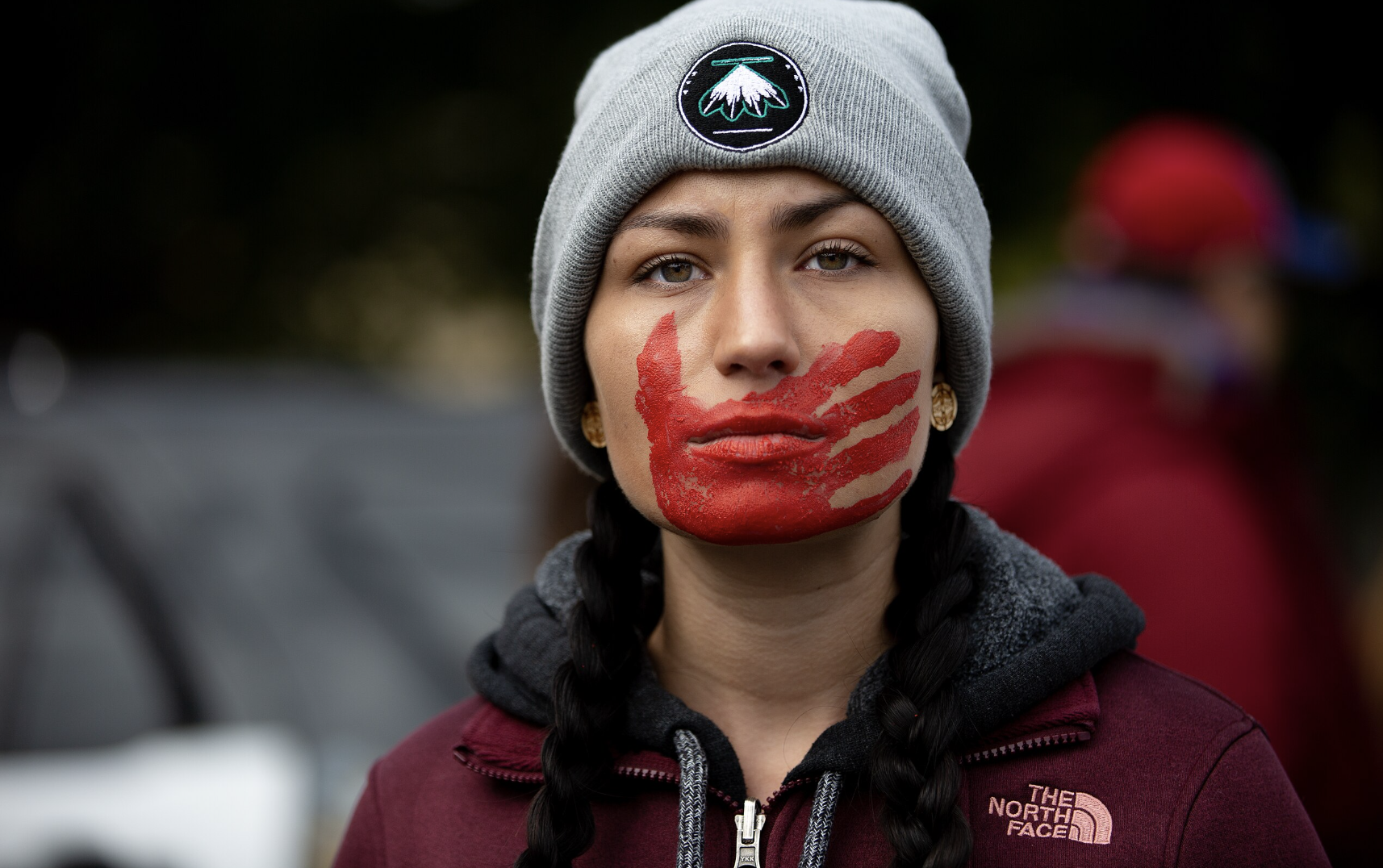
The red handprint painted across the mouth has become one of the most powerful symbols of protest in Canada; a stark reminder of the Indigenous women, girls, and 2SLGBTQQIA+ people whose lives have been taken through violence, and a refusal to allow this ongoing crisis to be ignored.
This image, often seen at marches and vigils, is not a trend. It is a direct challenge to colonial silence and a call for Canadians to confront the realities of systemic violence. Each handprint declares: You will not look away from us.
In 2011, Cindy Gladue, a 36-year-old Cree and Métis mother of two, was found dead in an Edmonton hotel room. The headlines did not write of her as a women whose life ended in violence, but with titles indignant to anyone having met such a tragic end. What followed remains one of the most disturbing examples of institutional racism and dehumanization in Canadian legal history.
During the 2015 trial, the court allowed Ms. Gladue’s preserved genital tissue to be entered and physically displayed as evidence before the jury, a shocking act that Indigenous women’s advocates, scholars, and Elders condemned as profoundly dehumanizing and culturally violent. Her body was treated as an object, dissected and presented publicly, reinforcing the historic colonial pattern of exploiting Indigenous women’s bodies as sites of harm rather than honouring them as sacred.
The accused was initially acquitted. In 2021, after years of protest and legal challenge, the Supreme Court of Canada ruled that systemic bias had corrupted the first trial, and a second jury found the accused guilty of manslaughter. Even then, the lesser conviction , rather than murder, reflected the deeply unequal value the Canadian justice system continues to place on Indigenous women’s lives.
Cindy’s case is not an isolated tragedy. It is a case study in the structural inhumanity that persists when colonial systems are permitted to define worth, evidence, and justice.
Cindy’s case exists alongside countless others that expose ongoing failures in policing, investigation, and legal processes involving Indigenous women and girls:
These cases show clear patterns: delayed responses, ignored warnings, inadequate investigations, and a lack of urgency. They reflect the broader, systemic devaluation of Indigenous lives.
In 2019, the National Inquiry into Missing and Murdered Indigenous Women and Girls (MMIWG) concluded that the violence facing Indigenous women, girls, and 2SLGBTQQIA+ people constitutes a race, identity, and gender-based genocide (National Inquiry, 2019). The inquiry heard over 2,300 testimonies and issued 231 Calls for Justice—legal and moral obligations intended to address policing, health care, social supports, and Indigenous self-determination.
Six years later, most remain unfulfilled.
Families continue to call for action, searches, and answers. This crisis is not only a social tragedy; it is a national failure that continues today.
Between 2009–2021, the homicide rate for Indigenous women and girls was six times higher than for non-Indigenous women. Indigenous women account for 1 in 5 female homicide victims while representing less than 5% of the population.
Cases involving Indigenous victims are less likely to result in charges or convictions, and sentences are often shorter (Statistics Canada, 2023). These numbers do not represent isolated events, they reflect the ongoing impact of colonization and systemic bias.
Vigils, the REDress Project, marches, and calls for landfill searches all serve as acts of remembrance and resistance.
These symbols challenge Canadians to witness, to remember, and to act.
Meaningful allyship requires sustained commitment, not symbolic gestures. Actions include:
The red hand is not only a symbol of protest- it is a witness. It marks every silence, every unsearched landfill, every unanswered call. It reminds us that these women and girls are not “missing”- they were taken. To honour them means to act. To remember them means to commit to change.
References
APTN News. (2023, Apr 14). Family of Cindy Gladue says province has ‘misplaced’ her remains. https://www.aptnnews.ca/featured/family-of-cindy-gladue-says-province-has-misplaced-her-remains/
García-Del Moral, P. (2024). State complicity: Settler colonialism, multisided violence, and the crisis of missing and murdered Indigenous women and girls. Social Politics. Advance online publication. https://doi.org/10.1093/sp/jxae013
National Inquiry into Missing and Murdered Indigenous Women and Girls. (2019). Reclaiming Power and Place: Final Report (Vol. 1a). Ottawa, ON: Government of Canada.
Statistics Canada. (2023, Oct 4). Court outcomes in homicides of Indigenous women and girls. Ottawa, ON: Government of Canada.
Canada. (2019). Reclaiming Power and Place: Final report of the National Inquiry into Missing and Murdered Indigenous Women and Girls (Vols. 1A, 1B, 2 & Calls for Justice). Privy Council Office. https://publications.gc.ca/site/eng/9.867037/publication.html
Black, J. (2010). The REDress Project. Winnipeg, MB: Public Art Initiative.